Rachel Martin, Indiana University of Pennsylvania
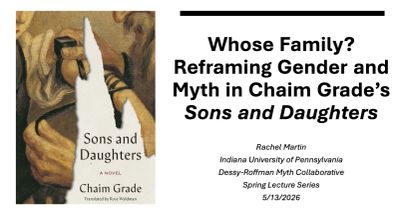
Whose Family? Reframing Gender and Myth in Chaim Grade’s Sons and Daughters
The above link will take you to a recording of the presentation.
Abstract:
Chaim Grade’s 600-page epic Sons and Daughters follows the family of Sholem Shachne, a
traditional rabbi, in Poland in the 1930s. Each of his sons and close relations chooses a different modern path, causing him much distress. With characters leaving to pursue secular education, Zionism, commerce, militant Marxism, and immigration to America, Grade shows the kaleidoscope of ways that traditional Jewish family expectations fractured during the interwar period.
This talk will challenge the default reading, which places Sholem Shachne at the center of the
story, by proposing a counter-reading that treats the female characters as the novel’s organizing mythic structure. Taking the female and male characters as separate cohorts, this talk first explores differences in language use and geographic mobility.
Next, this talk will focus on the rebbetzin, the characters who are wives of rabbis. Sholem
Shachne’s wife, Henna’le, her daughter Tiltza, and her stepmother Vigasia, occupy the same role in their respective communities, yet they vary in temperament, agency, and impact on the plot. This study considers whether they are presented as archetypes, tropes, or fully developed characters. Are these figures versions of a single inherited role? I will introduce a fourth fictional rebbetzin, Raizela, from the novel Deborah by Esther Kreitman, for further comparison.
To conclude, I will place Sons and Daughters into its historical context by putting it in conversation with another Yiddish novel, The Family Mashber. While Sons and Daughters was
written in the 1960s, looking back at the 1930s, The Family Mashber was written in the actual
1930s, looking back at Jewish family life in the 1870s. Is Grade revising an earlier myth of
family? The relative presence of women in each text will be compared, along with the role of
interiority in developing well-rounded characters for both narratives.

Presenter bio:
Rachel A. Martin is a PhD candidate in Literature and Criticism at Indiana University of
Pennsylvania. Her research explores multilingual poets, self-translation, and Yiddish literature.
She holds two master’s degrees and has taught English on three continents.