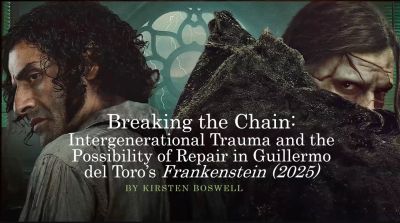
Kirsten Boswell, Indiana University of Pennsylvania
The above link will take you to a recording of the presentation.
Abstract:
Although Mary Shelley’s Frankenstein; or, The Modern Prometheus, critiques
Enlightenment rationality, patriarchal scientific ambition, and the terror of unbounded creation, Guillermo del Toro’s 2025 adaptation of the novel reframes it for a trauma-conscious twenty-
first century. He replaces its bleak, unresolved ending with a symbolic moment of care, intergenerational reckoning, and the possibility of repair. Rather than betraying Shelley’s
intentions, del Toro makes explicit what her text already encodes: a cycle of parent child trauma, abandonment, and inherited suffering operating between Victor and the Creature.
Del Toro’s Creature becomes a figure of trauma consciousness rather than moral
condemnation, aligning with his established Gothic aesthetic of wounded innocence and
historical afterlives of violence in films such as The Devil’s Backbone, Pan’s Labyrinth, and
Crimson Peak. As critics like Manuel Aguirre and Katherine Snyder suggest, his monsters
function not as spectacles of terror but as vessels of historical suffering. Integrating Jeffrey
Jerome Cohen’s monster theory with psychoanalytic frameworks from Freud, Melanie Klein,
and Winnicott, Victor’s catastrophic failure as a “good enough” parent produces a repetition
compulsion that del Toro’s film symbolically interrupts.
Ultimately, del Toro’s Frankenstein does not soften Shelley’s Gothic vision but refracts it
through the emotional vocabulary of twenty-first-century trauma culture, offering not closure but a culturally legible gesture toward repair in an era increasingly obsessed with inherited pain and healing.
Presenter bio:
Kirsten Boswell is an adjunct English professor at the University of Saint Francis. She is a
published writer with six short stories currently in print. She has a master’s degree from the
Citadel in English Literature. Her area of study was Medieval literature, particularly Arthurian
Literature, but she also studies classical and modern Gothic Romantic novels.