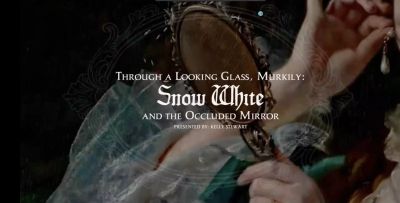
Kelly Stewart, Indiana University of Pennsylvania
Through the Looking-Glass, Murkily: Snow White and The Occluded Mirror
The above link will take you to a recording of the presentation.
Abstract:
“Mirror, mirror on the wall...”—so begins the iconic incantation that has shaped
generations of women’s self-perception. In both Disney’s Snow White (1937) and Anne Sexton’s “Snow White and the Seven Dwarfs” (1971), the mirror does not passively reflect truth but actively constructs the mythic life-cycle of femininity, fragmenting women into the sanctioned archetypes of Maiden, Mother, and Crone.
This talk introduces the Occluded Mirror, a heuristic model grounded in the optical
mechanics of both light and Disney’s cel animation—phenomena and processes such as
refraction, dispersion, looping, and afterimage—to examine how glass surfaces in Snow White
(the mirror, the coffin, the television screen) serve as ideological instruments. Long regarded as truth-tellers, these surfaces are marred by occlusions: subtle yet deeply embedded societal relics that distort perception and frame female identity within rigid, acceptable forms.
Engaging feminist criticism and postmodern fairy-tale theory, including work by scholars
such as Linda Hutcheon and Cristina Bacchilega, this talk reconsiders and reflective surfaces like the mirror as gender-structuring mythic instruments—widely trusted across time as arbiters of truth, yet operating today as living technologies of judgment and control. By analyzing how these sites enforce, project, and reproduce scripts of femininity, this framework helps to illumine how inherited myths continue to structure identity—often without our knowing.

Presenter bio:
Kelly Stewart is a PhD student in Literature & Criticism at Indiana University of
Pennsylvania, drawn to myth, fairytale, and the interpretive possibilities they open across time.
Her interests span Old and Middle English literature, the long eighteenth century, Romantic and Gothic writing, and fantasy traditions. She is also fascinated by liminality and hybridity, and the unexpected convergences between science fiction and Romanticism.