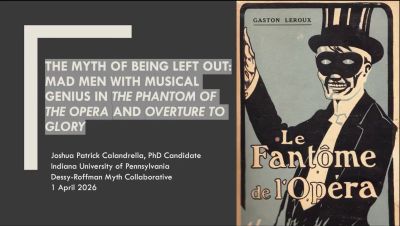
Joshua Calandrella, Indiana University of Pennsylvania
The above link will take you to a recording of the presentation.
Abstract:
In this lecture I reimagine the myth of the musical genius through an investigation of the
tragic hero and how he attempts, fails, and succeeds to integrate rejection through a
renewed identity formation inspired by his desire to compose. Whereas Gaston Leroux’s
French serial detective novel, The Phantom of the Opera (1910), relies on allusions to
popular nineteenth-century myths adapted for French opera (Faust, Don Juan) the
American Yiddish film, Overture to Glory (1940), directed by Max Nosseck, capture the
multilingual overlap between Jews, gentiles, sacred liturgy, and nationalist opera. Leroux
weaves fictional documentarian evidence with character witness testimony to resolve the
mysterious identity of the Opera Ghost and his relationship to Christine Daaé, a young
soprano whose disappears with her fiancé Raul, the Vicomte de Chaney, after the
discovery of the corpse of his brother, Count Philipe; however, the Phantom is a man
named Erik, a disfigured composer, violinist, and vocalists living below the lower
mezzanine. Likewise, Overture to Glory depicts the tragedy of Yoel Duvid Strashunsky, the
historic cantor who left Vilna to study Polish Opera in Warsaw and suffered a tragic death
from consumption and melancholia after the death of his children. Although Erik and Yoel
Duvid create masterworks of art, they are unable to compose a stable life—stuck between
heaven and earth, the Opera house and the shul. Because they reject the possibility to
experience pleasure through their creations, they become tragic heroes, who, in the words
of psychoanalyst Adam Phillips, “creates havoc... and tries to solve the problem of
exclusion by seeking to exclude his excluders, in retaliation.” Thus, musical genius, no
longer just a man, transforms into a lasting legend through his madness and monstrosity, a
broken vessel that ensure the belonging of the legacy of his art, but never the genius
himself.

Presenter bio:
Joshua Patrick Calandrella is a PhD candidate in Literature and Criticism at Indiana
University of Pennsylvania. His literary studies weave together the regrowth of twentieth-century Yiddish Poetry after the Holocaust and the layering of Jewish literary history across
space and time. He also studies Biblical Hebrew, Chassidic literature, World Mythology,
Latin American Literature, and the interweaving of Romanticism and Mysticism in European
and American novels. When he is not teaching English Composition at the University of
Pittsburgh Johnstown, Joshua writes poetry and co-teaches with the IUP Yiddish club in
surrealist yeshiva.